Boxing Someone Who Threw a Hit and Never Threw the Same Hit Again
Boxing Vocabulary
This page covers the vocabulary and language of battle by looking at its background, equipment and people. Check your understanding with the vocabulary quiz and comprehension quiz.
 Fighting with the fists seems to come naturally to homo beings. Whether kids are playfully fighting for fun, or adults are fighting in anger, many will protect themselves by holding their fists in forepart of the face up, and attack past punching with their fists. The same actions course the footing of boxing. For thousands of years, men and boys, and sometimes girls and women, take fought in boxing matches, sometimes with gloves and protective gear, and sometimes with bare fists and piddling or no protection. Boxing has always been a controversial sport, loved by some and hated by others. Its fans encounter information technology equally the most exciting and challenging of sports, a truthful test of a person'due south physical strength, mental alertness and courage. But those who dislike boxing encounter it every bit a brutal and unsafe action, and some fifty-fifty believe information technology should exist banned.
History
Carvings and paintings show people fighting with their fists over five,000 years ago in ancient Sumeria and over 3,000 years agone in ancient Egypt. Nosotros don't know if these fights were a regulated sport similar boxing, or a form of trigger-happy entertainment similar gladiator fighting in ancient Rome. But by the time of the ancient Greeks, boxing had get a sport and it was role of the Olympic Games as early on as 688 B.C. Information technology and so became popular in other parts of Europe, but in 500 A.D. it was banned by the Roman Emperor Theodoric the Great. Theodoric was a Christian who believed that the human face was made in God'south paradigm, and that by damaging the face up, boxing also damaged God'south image.
Modern boxing had its origins in England during the early 18th century, when bare-knuckled prizefighting was popular. This was non a regulated sport, still, only an illegal business run by criminal gangs who earned coin by selling tickets and taking bets. There were no written rules, no weight divisions, no rounds or time limits, no protective gear like gloves, and no referee. Many fighters were seriously injure, and some were even killed.
Improvements began with the introduction of the London Prize Ring rules in 1743. Hitting a fighter while he was downwards was no longer allowed, and if a fighter went down and could not continue later on a count of thirty seconds, the fight was over. In 1853, more rules were introduced, with biting, head-butting and hitting "beneath the chugalug" existence banned and called fouls. Improvement connected with the introduction of the Marquess of Queensberry rules in 1867, which marking the real transformation of prize-fighting into the sport of battle. Matches would be held in a 24-foot-foursquare band, with three-minute rounds and one-minute breaks between them. A fighter who was knocked downwardly was given a ten-second count, and if he couldn't get up in time, the referee would terminate the fight. Thickly padded boxing gloves had to be worn to protect fighters from facial and mitt injuries. The Queensbury rules nonetheless class the ground of battle to this day.
Boxing'southward image was profoundly improved by its return to the Olympic Games in 1908, and by the establishment of battle commissions to farther regulate the sport. They developed a ratings organisation, oversaw regional and national competitions and globe championship matches, and handled whatsoever disputes and protests.
How Boxing Works
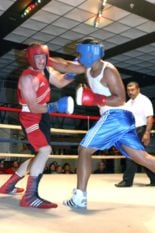 Modern boxing has two main forms; amateur and professional person. Amateur boxing can exist seen at colleges and universities, at national and international tournaments, and at major sporting events such every bit the Olympic, Commonwealth and Asian Games. Protective headgear must exist worn (come across photo at right), the bouts are limited to iii or 4 two-minute rounds, and results are decided on a strict points-scoring system. Professional battle is far more than pop than apprentice boxing, which is often seen every bit a way of developing the skills needed for the professional grade of the sport. Matches are normally much longer than apprentice bouts, lasting for 10 to twelve three-infinitesimal rounds, and protective headgear is not permitted. Fights are more often decided by knockout or technical knockout, meaning the referee decides a fighter cannot go on because of injuries such as cuts to the confront, or because of exhaustion. But if a fight goes the total distance, the result is decided by a team of three judges who proceed score during the fight by awarding points for legal punches. The referee can as well instruct the judges to deduct points if a fighter commits a foul. If all the judges agree on which fighter is the winner, it is a unanimous decision, only if they disagree, the upshot is a divide determination.
Boxing involves techniques for both attacking and defending. The merely attacking movement allowed in boxing is punching. Boot, kneeing, elbowing, caput-butting, holding and throwing are not allowed. There are four basic punches; the jab, the cross, the hook and the uppercut. The jab is a quick, straight punch thrown with the pb hand, which for a right-handed, orthodox fighter, is the left hand, and for a left-handed, southpaw fighter is the right hand. The jab is not a powerful dial, but it's good for scoring points, for checking distance, and for starting a combination of punches. A cantankerous is a powerful, straight punch thrown with the rear hand, which is the right mitt for orthodox fighters and the left hand for southpaws. It tin can follow a jab to create the classic "one-two" combination. The hook is a semi-circular dial thrown with the lead paw to the side of the opponent's head. A hook can also target the lower body and this punch is sometimes called a "rip". The uppercut is a rising punch thrown with the rear hand, aimed at the jaw or deep into the stomach area. The right uppercut followed by a left hook is a powerful and dangerous combination.
Merely as important as the attacking techniques are the defensive techniques. These include the protective guard, too equally techniques to evade and block punches. There are several defensive positions, called guards, which boxers use. In a high guard both hands are raised to protect the confront, while in a low guard the rear mitt is held lower to add protection to the body. To evade punches and avoid beingness hit, boxers utilise a number of moves. One such movement is slipping, in which a boxer turns his body slightly from the hips to let a punch "slip" by. Another is swaying, in which a boxer "sways" straight back from the hips in order to move his head dorsum and out of fashion of an budgeted dial. Boxers also bob and weave, meaning they evade a punch past bobbing, or angle the legs and lowering the caput, and and then movement into an attacking position by weaving, or straightening up while stepping in towards the opponent. Other defensive techniques include parrying, blocking and clinching.
In order to win a fight, a boxer must use these techniques for attacking and defending inside a expert overall strategy. In the early rounds of a fight, boxers figure out what their opponent'due south strong points and weak points are, and so try to find a winning strategy, taking into business relationship their own strengths and weaknesses as well. Equally such, boxing is very much a "mental" contest likewise as a physical one, and champion boxers need to be quick thinkers also as quick punchers and movers.
About Famous Boxer
Muhammad Ali
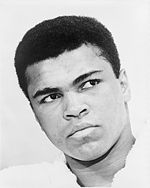 On January 17, 1942, Cassius Marcellus Dirt Jr. was born in Louisville, Kentucky, United states of americaA. He grew upwards to become the almost famous boxer of all time, though most people at present know him every bit Muhammad Ali, the proper noun he adopted in 1964 when he converted to Islam. Ali is a former 3-time World Heavyweight Champion and winner of an Olympic gold medal. In 1999, he was crowned "Sportsman of the Century" by Sports Illustrated and the BBC. Ali had the perfect body for a boxer. He stood 6-ft 3-in tall (one.91 m) and had a strong physique, but he was every bit fast every bit a much smaller man. He used his foot-speed and quick body move to avoid punches, and this allowed him to use a depression guard instead of the high guard unremarkably used to protect the face. This made Ali look very relaxed in the band, and he would ofttimes seem to be "playing" with his opponent, in the mode a cat might "play" with a mouse, earlier suddenly stepping upward the pace and going "in for the kill". Afterwards in his career, when he slowed downwardly a lilliputian, Ali adult a new style he chosen "rope-a-dope". With this technique he would stay on the ropes with a high baby-sit and cover up to absorb punches to his artillery and torso, or lean back on the ropes and sway to avoid the punches, until his opponent wore himself out. And then Ali would begin a potent assail which commonly concluded the fight with a knockout. Muhammad Ali retired from boxing in 1981, though his influence on the sport will go along forever. The beauty of his early mode, which Ali himself described as "Bladder like a butterfly, sting similar a bee", volition never be forgotten by boxing's many fans.
Boxing Vocabulary List
| word | example judgement | meaning |
|---|---|---|
| bare-knuckled | Blank-knuckled fighting was popular until the nineteenth century. | without protective gloves |
| block | He could block most of the punches, but some got through and hit his face. | use the hands, arms and shoulders to terminate punches from landing on the confront or body |
| blow | A blow to the stomach can make it difficult to exhale. | strike or striking; punch with a clenched fist |
| tour | Mike had his first bout in professional person boxing when he was sixteen. | organized fight in boxing or wrestling |
| clinch | Both fighters were tired and clinching too much, so the referee told them to "suspension". | lean on and agree i's opponent instead of fighting |
| combination | His best combination was a left jab followed by a right cross, and then a left hook. | serial of punches thrown in sequence |
| counterpunch | Subsequently throwing a right hook, he left himself open and got hitting by a strong counterpunch. | punch thrown subsequently an opponent has thrown a dial |
| cantankerous | An orthodox boxer usually throws a cross with his stronger right arm. | a straight power dial thrown directly at the target |
| fist | He raised his arms and held his fists in forepart of his face to protect himself. | tightly closed hand with the fingers bent in towards the palm |
| foul | The referee warned Mike after he threw another foul punch. | unfair act or un-sportsmanlike comport |
| gloves / battle gloves | Boxing gloves help to foreclose damage to the hands, especially the knuckles. | protective padded coverings for the hands, usually made of leather |
| head-butt | The referee stopped the fight after a head-butt opened a cutting over Ali'south left eye. | foul of hitting an opponent with the head |
| holding | After warning Joe for holding several times, the referee deducted points. | foul of preventing an opponent from punching by holding their arms against their body |
| hook | He finished the combination with a right hook to the jaw. | curt sideways within dial delivered with the elbow bent |
| jab | Fighters use the jab to earn points, but it'southward not a powerful punch. | quick punch with the leading hand, direct from the chin to the target |
| kidney dial | Referees disqualify fighters who utilise kidney punches to injure their opponent. | illegal blow to the lower dorsum which tin can damage the kidneys |
| knockdown | A referee usually starts an eight count afterwards a knockdown. | occurs when a boxer is hit and whatsoever office of his body, other than the feet, touches the floor |
| knockout / KO | He has won seventeen fights, xiii of them by knockout. | occurs when a boxer is striking hard and loses consciousness |
| low blow | The referee stopped the fight to permit Harada recover from a low blow. | foul accident to the surface area beneath the stomach, including the genitals |
| match | Our son won his first boxing match terminal night, and we're very proud of him. | an organized contest betwixt people or teams |
| neutral corner | He went to the neutral corner and waited for his opponent to go upward off the floor. | corner of the ring a boxer must go to after knocking downwardly an opponent |
| parry | He stood on the ropes with his gloves upward, parrying the punches as they came. | fend off punches with the gloves |
| promoter | The fighters said the promoter didn't pay them equally much every bit he said he would. | visitor or person who finances and organizes a sporting or amusement event |
| dial | People say he can't take a adept punch, and is hands knocked out. | strike with a clenched fist |
| rabbit punch | Dirty fighters endeavour to hurt their opponents with illegal blows similar rabbit punches. | illegal punch to the back of the caput or neck which can damage the spinal cord |
| band | The fighters climbed through the ropes and into the ring. | raised foursquare platform on which boxing matches are held |
| ropes | Ali would stay on the ropes and expect for his opponent to wear himself out. | lengths of strong cord enclosing a boxing ring |
| rounds | In men's boxing rounds last for three minutes, but in women's boxing they last for 2 minutes. | time periods in a boxing match for fighting, separated by one-minute breaks |
| southpaw | Proficient boxers know how to deal with any opponent, including unorthodox fighters like southpaws. | left handed fighter who jabs with the right hand and throws power punches with the left hand |
| sparring | He was 1 of Ali'south regular sparring partners. | when boxers brand the motions of boxing without landing heavy blows, as a kind of grooming |
| split decision | It was a close fight, and the winner won it on a split conclusion. | occurs when 2 of the three judges score one boxer as the winner, while the third guess scores the other boxer as the winner |
| standing eight count | The referee checked the fighter during the standing eight count, and so allow him continue. | occurs when a boxer looks hurt and the referee stops the fight and counts to eight to see if he can go along |
| sucker punch | I was injure by a sucker punch that got me in the breadbasket when I wasn't looking. | unexpected dial that catches a boxer by surprise |
| technical knockout / TKO | Robert says he would take won the fight if it hadn't been stopped on a technical knockout. | occurs when a fighter loses because a legal dial causes a cut, usually on his face, that stops the fight |
| unanimous decision | He won the fight easily and got a unanimous determination from the judges. | occurs when all three judges agree on who is the winner of a fight |
| upper cut | My best dial was an upper cutting that hit him on the jaw and about knocked him out. | upward punch aimed at the jaw or the stomach |
| weight classes | Boxers sometimes move to a different weight class, often to a heavier one. | competition divisions based on weight, such as "heavyweight" |
| weigh-in | The boxers tried to upset each other with insults at the weigh-in before the fight. | pre-fight meeting for boxers to be weighed to make sure they are inside their weight course limits |
hamptonnobroact49.blogspot.com
Source: https://www.englishclub.com/vocabulary/sports-boxing.htm
0 Response to "Boxing Someone Who Threw a Hit and Never Threw the Same Hit Again"
Post a Comment