19th Century Peer Review for Heart of Darkness
In our series, Guide to the classics, experts explain primal works of literature.
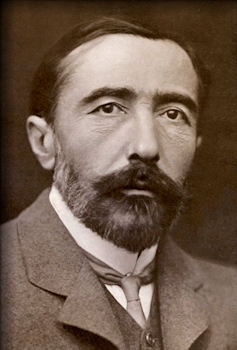
Joseph Conrad's Heart of Darkness - or "The Center of Darkness", as information technology was known to its first readers - was first published as a serial in 1899, in the popular monthly Blackwood's Magazine. Few of that mag's subscribers could accept foreseen the fame that Conrad's story would somewhen garner, or the tearing debates information technology would later provoke.
Already, in 1922, the American poet T.S. Eliot thought the volume was Zeitgeist-y enough to provide the epigraph for his epoch-defining poem, The Waste material Land - although another American poet, Ezra Pound, talked him out of using it.
The same thought occurred to Francis Ford Coppola more than than l years later, when he used Conrad's story as the framework for his phantasmagoric Vietnam War picture show, Apocalypse At present. Echoes of Center of Darkness can popular up almost anywhere: the chorus to a Gang of Four vocal, the title of a Simpsons episode, a scene in Peter Jackson's 2005 King Kong remake.
Consider 1 terminal Middle of Darkness allusion, from Mohsin Hamid's 2017 Man Booker-shortlisted novel, Exit Westward. In the novel's opening pages, a man with "nighttime skin and nighttime, woolly hair" appears in a Sydney chamber, transported there by one of the mysterious portals that take appeared around the world, connecting stable, prosperous countries with places that people need to escape from.
The "door", as these wormholes are chosen, is "a rectangle of complete darkness — the middle of darkness". This is a more complicated kind of Conrad reference. Here, "middle of darkness" is a shorthand for European stereotypes of Africa, which Conrad's novel did its function to reinforce.
Hamid'southward line plays on racist anxieties near immigration: the idea that sure places and peoples are archaic, exotic, dangerous. For contemporary readers and writers, these questions take get an unavoidable part of Conrad'due south legacy, as well.
Up the river
Eye of Darkness is the story of an English seaman, Charles Marlow, who is hired by a Belgian company to captain a river steamer in the recently established Congo Complimentary State. Nearly equally soon equally he arrives in the Congo, Marlow begins to hear rumours about another visitor employee, Kurtz, who is stationed deep in the interior of the state, hundreds of miles up the Congo River.
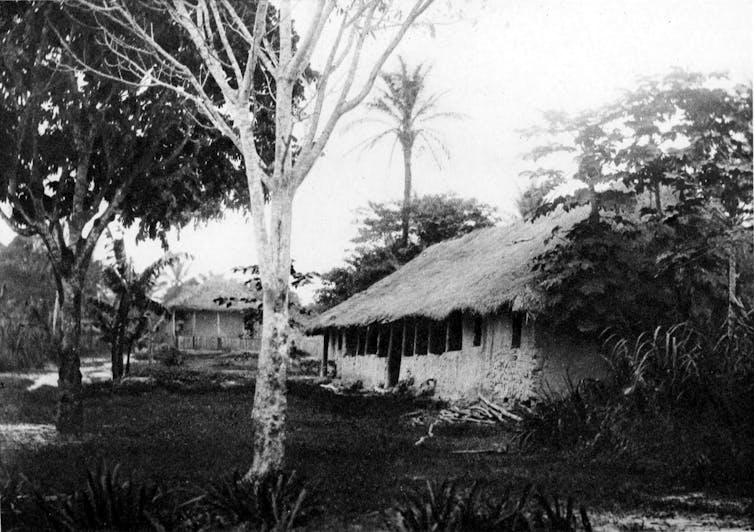
The second half of the novel - or novella, as it's ofttimes labelled - relates Marlow'south journey upriver and his meeting with Kurtz. His wellness destroyed by years in the jungle, Kurtz dies on the journey back down to the coast, though not earlier Marlow has had a chance to glimpse "the arid darkness of his heart". The coda to Marlow's Congo story takes place in Europe: questioned by Kurtz's "Intended" about his last moments, Marlow decides to tell a comforting lie, rather than reveal the truth nigh his descent into madness.
Although Conrad never met anyone quite like Kurtz in the Congo, the construction of Marlow's story is based closely on his experiences as mate and, temporarily, captain of the Roi des Belges, a Congo river steamer, in 1890. Past this time, Conrad, built-in Józef Teodor Konrad Korzeniowski in the Russian-ruled role of Poland in 1857, had been a seaman for about xv years, rising to the rank of master in the British merchant service. (The remains of the but sailing ship he ever allowable, the Otago, have ended up in Hobart, a rusted, half-submerged vanquish on the banks of the Derwent.)

Sick with fever and disenchanted with his colleagues and superiors, he bankrupt his contract after but half dozen months, and returned to London in early 1891. Three years and two ships later, Conrad retired from the ocean and embarked on a career as a author, publishing the novel that he had been working on since earlier he visited the Congo, Almayer'due south Folly, in 1895. A 2d novel, An Outcast of the Islands, followed, along with several stories. Conrad's second career was humming along when he finally set about transforming his Congo experience into fiction in 1898.
Darkness at domicile and abroad
Heart of Darkness opens on a ship, but non one of the commercial vessels that feature in Conrad'south sea stories. Rather, it's a private yacht, the Nellie, moored at Gravesend, about 20 miles east of the City of London. The five male friends gathered on lath were once sailors, only everyone except Marlow has since inverse careers, every bit Conrad himself had done.
Similar sail, which was rapidly beingness displaced past steam-ability, Marlow is introduced to united states of america as an anachronism, still devoted to the profession his companions have left backside. When, amidst the gathering "gloom", he begins to reminisce about his stint as a "fresh-water sailor", his companions know they are in for ane of his "inconclusive experiences".
Setting the opening of Eye of Darkness on the Thames too immune Conrad to foreshadow one of the novel'south central conceits: the lack of any absolute, essential difference betwixt and so-called civilized societies then-called primitive ones. "This, too", Marlow says, "has been 1 of the dark places of the globe", imagining the impressions of an ancient Roman soldier, arriving in what was and then a remote, desolate corner of the empire.
During the second half of the 19th century, spurious theories of racial superiority were used to legitimate empire-building, justifying European rule over native populations in places where they had no other obvious right to be. Marlow, however, is too cynical to take this convenient fiction. The "conquest of the globe", he says, was not the manifest destiny of European peoples; rather, it simply meant "the taking it abroad from those who have a different complexion or slightly flatter noses than ourselves."
The idea that Africans and Europeans have more than in common than the latter might care to admit recurs after, when Marlow describes observing tribal ceremonies on the banks of the river. Confronted with local villagers "stamping" and "swaying", their "eyes rolling", he is shaken by a feeling of "remote kinship with this wild and passionate uproar".
Whereas nigh contemporary readers will exist cheered by Marlow's scepticism about the project of empire, this prototype of Congo'due south indigenous inhabitants is more problematic. "Going upward that river", Marlow says, "was like travelling back to the earliest ancestry of the world", and he accordingly sees the dancing figures every bit remnants of "prehistoric man".
Heart of Darkness suggests that Europeans are not essentially more highly-evolved or enlightened than the people whose territories they invade. To this extent, it punctures ane of the myths of imperialist race theory. But, every bit the critic Patrick Brantlinger has argued, it also portrays Congolese villagers every bit primitiveness personified, inhabitants of a land that fourth dimension forgot.
Kurtz is shown every bit the ultimate proof of this "kinship" between enlightened Europeans and the "savages" they are supposed to be civilising. Kurtz had once written an idealistic "written report" for an organisation called the International Society for the Suppression of Fell Customs. When Marlow finds this manuscript among Kurtz's papers, all the same, it bears a hastily-scrawled annex: "Exterminate all the brutes!" The Kurtz that Marlow finally encounters at the finish of the novel has been consumed past the same "forgotten and brutal instincts" he in one case intended to suppress.
Adventure on acid
The European "gone native" on the fringes of empire was a stock trope, which Conrad himself had already explored elsewhere in his writing, simply Middle of Darkness takes this platitude of purple adventure fiction and sends it on an acid trip. The manic, emaciated Kurtz that Marlow finds at the Inner Station is straight out of the pages of late-Victorian neo-Gothic, more than Bram Stoker or Sheridan Le Fanu than Henry Rider Haggard. The "wilderness" has possessed Kurtz, "loved him, embraced him, got into his veins" — information technology is no wonder that Marlow feels "creepy all over" simply thinking nearly it.

Kurtz's famous terminal words are "The horror! The horror!" "Horror" is too the feeling that Kurtz and his monstrous jungle compound, with its decorative display of human being heads, are supposed to evoke in the reader. Along with its various other generic affiliations — imperial romance, psychological novel, impressionist bout de strength — Heart of Darkness is a horror story.
Conrad's Kurtz besides channels turn-of-the-century anxieties most mass media and mass politics. One of Kurtz'southward defining qualities in the novel is "eloquence": Marlow refers to him repeatedly as "A voice!", and his report on Savage Customs is written in a rhetorical, highfalutin style, short on practical details but long on sonorous abstractions. Marlow never discovers Kurtz's real "profession", but he gets the impression that he was somehow connected with the press — either a "journalist who could paint" or a "painter who wrote for the papers".
This seems to be confirmed when a Belgian journalist turns upwards in Antwerp after Kurtz's death, referring to him as his "dear colleague" and sniffing around for anything he tin can use as re-create. Marlow fobs him off with the bombastic written report, which the journalist accepts happily enough. For Conrad, implicitly, Kurtz'due south mendacious eloquence is just the kind of affair that unscrupulous popular newspapers like to print.
If Kurtz's "colleague" is to be believed, moreover, his peculiar gifts might also take found an outlet in populist politics: "He would take been a excellent leader of an extreme party." Had he returned to Europe, that is, the same faculty that enabled Kurtz to impose his mad will on the tribespeople of the upper Congo might have plant a wider audience.
Politically, Conrad tended to be on the right, and this epitome of Kurtz as an extremist demagogue expresses a habitual pessimism near mass democracy — in 1899, still a relatively recent phenomenon. Nonetheless, in the light of the totalitarian regimes that emerged in Italy, Federal republic of germany and Russia afterwards 1918, Kurtz's combination of irresistible charisma with megalomaniacal brutality seems prescient.
These concerns about political populism also resonate with recent democratic processes in the United states and the UK, amidst other places. Only Conrad's accent on "eloquence" now seems quaint: equally the 2016 US Presidential Election demonstrated, an absenteeism of rhetorical flair is no handicap in the loonshit of contemporary populist debate.
Race and empire
Center of Darkness contains a bitter critique of imperialism in the Congo, which Conrad condemns every bit "rapacious and pitiless folly". The backfire against the systematic corruption and exploitation of Congo'south indigenous inhabitants did not actually go underway until the first decade of the 20th century, so that the anti-imperialist theme was alee of its time, if just by a few years. Nor does Conrad have any patience with complacent European beliefs almost racial superiority.

Still, the novel also contains representations of Africans that would rightly exist described as racist if they were written today. In particular, Conrad shows little involvement in the experience of Marlow's "cannibal" shipmates, who come across as exotic caricatures. Information technology is images like these that led the Nigerian novelist Chinua Achebe to denounce Conrad as a "bloody racist", in an influential 1977 essay.
One response to this criticism is to argue, every bit Paul B. Armstrong does, that the lack of more rounded Congolese characters is the bespeak. Past sticking to Marlow'south limited perspective, Heart of Darkness gives an authentic portrayal of how people run into other cultures. But this doesn't necessarily make the images themselves any less offensive.
If Achebe did not succeed in having Heart of Darkness struck from the canon, he did ensure that academics writing most the novel could no longer ignore the question of race. For Urmila Seshagiri, Eye of Darkness shows that race is not the stable, scientific category that many Victorians thought information technology was. This kind of argument shifts the debate in a unlike management, abroad from the author's putative "racism", and onto the novel's complex portrayal of race itself.
Perhaps because he was himself an alien in Britain, whose first career had taken him to the farthest corners of the globe, Conrad'south novels and stories oftentimes seem more in tune with our globalized earth than those of some of his contemporaries. An émigré at 16, Conrad experienced to a high degree the kind of dislocation that has go an increasingly typical modern status. Information technology is entirely appropriate, in more means than 1, for Hamid to allude to Conrad in a novel about global mobility.
The paradox of Middle of Darkness is that it seems at once then improbable and and so necessary. It is incommunicable not to exist astonished, when you think of it, that a Shine ex-crewman, writing in his tertiary language, was ever in a position to writer such a story, on such a field of study. And yet, in another way, Conrad's life seems more determined than most, in more than direct contact with the groovy forces of history. It is from this point of view that Eye of Darkness seems necessary, even inevitable, the product of nighttime historical energies, which continue to shape our contemporary world.
hamptonnobroact49.blogspot.com
Source: https://theconversation.com/how-conrads-imperial-horror-story-heart-of-darkness-resonates-with-our-globalised-times-94723
0 Response to "19th Century Peer Review for Heart of Darkness"
Post a Comment